As communities nationwide marked the Marine Corps’ 250th anniversary, the date brings deep reflection for veteran Dave Cantrelle, shaped by its legacy.
Nov. 10, 1775, marks the exact date the United States Continental Congress passed a resolution establishing two battalions of Marines to serve as a naval infantry force during the American Revolution.
Recruitment began at Tun Tavern in Philadelphia, which is considered the birthplace of the Marine Corps.
“That’s one of the first dates we are told about whenever we join. November 10, 1775,” says U.S. Marine veteran David Cantrelle.
As communities across the country gathered this year to celebrate the Marine Corps’ 250th anniversary, pride and remembrance filled the air as stories passed down through generations.
Among the veterans honoring the historic moment stood Cantrelle, a Marine from a small town stepping into military service, who embodies the dedication that has defined the Corps for more than two centuries.
Becoming a Marine
Cantrelle, a Larose native, joined the Marines in his senior year of high school. His two uncles were Marines, and at the time, his three cousins had joined the Marine Corps.
One of his uncles was a helicopter crew chief like himself, and he saw extensive combat in Vietnam.
“Growing up, we looked up to our families that served,” Cantrelle said. “A lot of people think that people join just to be in war and combat. That’s not why I joined. I went in because I wanted to make a difference.”
As a child, Cantrelle learned that many astronauts started as Navy pilots, further fueling an interest already sparked by his role models.
It seemed the opportunity came knocking when, soon after, a speaker named David Toma arrived at his school in South Lafourche.
After listening to Toma speak, Cantrelle sat in the stands, eager to talk to him. Cantrelle sat down one-on-one with him and spoke about his goals and plans. Toma told him the Marine Corps would be a great place for him to start.
“From that point on, I decided I was going to be a Marine,” Cantrelle said.
Life in the Marines
From Oct. 19, 1982, to Jan. 6, 1983, Cantrelle went to boot camp and graduated top of his class. He went to Memphis to attend his first basic helicopter course, with ambitions of becoming a helicopter mechanic.
He then moved to Jacksonville, North Carolina, where he would be stationed for the next seven years.
Cantrelle was deployed to the Mediterranean Sea three different times on a rotation. He went in 1985, 1987, and 1990, but on his third deployment, he did an operation in Africa called Operation Sharp Edge.
“We went and evacuated the American embassy and our allied embassies from a country called Liberia,” Cantrelle recalled.
“They were having a civil war at the time, and it was getting very close to coming into the city, where the embassies were located.
We pulled out 1,700 people and transported them just north of Liberia, to Sierra Leone, and they were able to fly to their respective countries.”
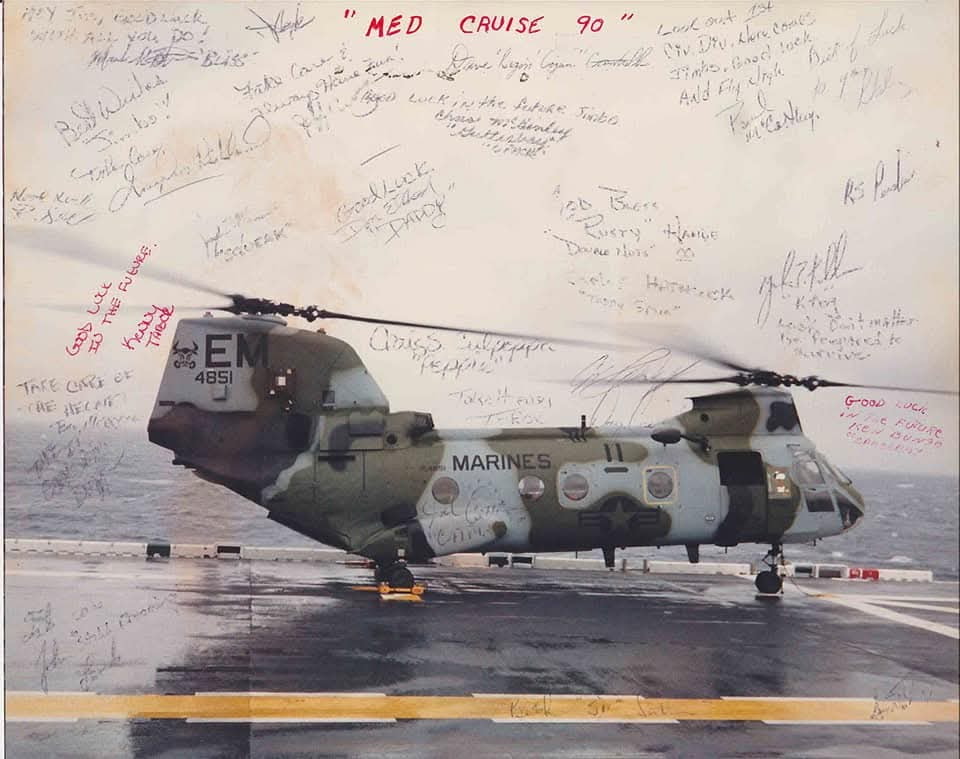
(Photo by: Jim herriven )
After returning from that deployment, Cantrelle and his crew did not expect to be deployed again. Instead, they were surprised when they were assigned to deploy to Saudi Arabia, departing Jan. 5. That date also marked his original discharge date; Cantrelle knew that would no longer be possible.
He was discharged June 21, 1991, after seven years and eight months in the Marine Corps.
Reflecting on his service
Now, Cantrelle reflects on the Marine Corps’ beginnings at Tun Tavern in 1775. This special group of fighters put together the first battalions as naval infantry during the American Revolutionary War.
“It means a hell of a lot to everyone who served in the Marines. The interesting thing for me is that not only is it the Marine Corps birthday, but November 10 was my mom and dad’s anniversary, so it holds two important times in my life,” Cantrelle said.
Looking ahead, Cantrelle remains hopeful, believing today’s Marines will carry the legacy forward with the same pride and grit as those before them.

(Photo by: Tim Hopkins)
“When somebody joins the Army, when they go to boot camp, they’re already calling them Soldiers,” he said.
“When someone joins the Navy, during boot camp, they’re already called sailors. When you go into the Air Force during boot camp, they already call you an airman. In the Marine Corps, when you go to boot camp, you’re not called a Marine. You’re called a recruit. When you get to that final week, is when you earn your Eagle Global Anchor and the title, Marine.”
As the Marine Corps marks its 250th anniversary, Cantrelle’s story stands as a testament to its enduring spirit, reminding us that the strength of the Marines lies not only in their history but in the individuals who carry that legacy forward each day.
“At 60 years old, there is no way I could do any of that stuff today, but yeah, it was the best choice I ever made,” Cantrelle said.