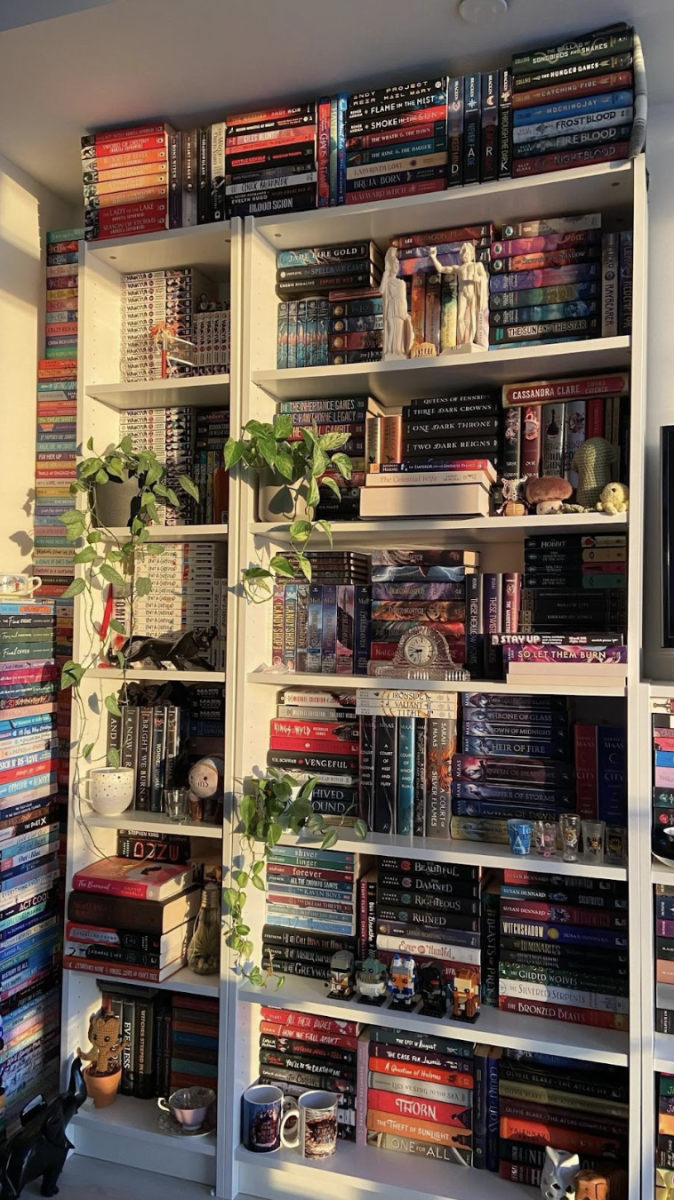
In 2025, 51 million romance novels were purchased off bookshelves. Several sources claim that romance currently stands as the highest-grossing book genre.
One well-known subgenre of romance is what many BookTokers lovingly refer to as “smut”. This specific, erotic subgenre has received its fair share of praise and pushback. Oftentimes, it allows individuals to fantasize freely about a connection they could have. Others criticize it, however, claiming that it sets unrealistic expectations for real-life relationships.
Some take the argument even further, insisting that smut is anti-women and anti-feminism.
Is it?
To argue one way or the other, we have to define feminism and anti-feminism, or sexism. According to Press Books, “Feminism and sexism are generally two sides of the same coin. Feminism refers to the belief that women and men should have equal opportunities in economic, political and social life, while sexism refers to a belief in traditional gender role stereotypes and in the inherent inequality between men and women.”
So how could the subgenre, smut, be anti-women? While some argue that smut could be considered “degrading material”, a study published by the National Library of Medicine shows evidence that sexual autonomy (choice) is a key component for women’s happiness. The study defines this autonomy as a “human right to protect and maintain an informed decision over one’s body, one’s sexuality and one’s sexual experience.”
Every time a woman chooses to pick up erotic literature, she’s exercising her right to have sexual autonomy, and thus, her right to happiness. If a woman chooses not to read this genre, she is still exercising her autonomy and thus is still choosing feminism and personal happiness.

Generally speaking, the choice to read books of any kind has not always been in women’s hands. For centuries, the act of reading was prohibited for women by law and societal expectations across various parts of the world. In some parts of the world, it still is.
Despite societal pushback, many women have led an inked protest. Whether it be by reading or writing the books themselves, literature has been an essential tool in the feminist movement. As the number of books written by women began to grow in the U.S., frustration among men surfaced. Nathaniel Hawthorne (1804-1864), a renowned American novelist, once wrote regarding his opinion of women who chose to write and publish their work.
“America is now wholly given over to a damned mob of scribbling women, and I should have no chance of success while the public taste is occupied with their trash, and should be ashamed of myself if I did succeed,” Hawthorne wrote.
Vile opinions towards female authors have since dissipated, or perhaps lost visibility. Women authors now account for 50.45% of authors in the U.S. On average, female authors’ salaries are 96% of the value of male authors’ salaries.
Trash? Our country’s readers do not seem to think so.
In summary, the action of a woman choosing what she wants to read is an act of feminism. Thus, generally speaking, choosing to read smut is not anti-feminism. Although a more nuanced discussion about specific books could be had.
Specific titles that slide rose-colored glasses over abusive relationships (I’m looking at you, “Haunting Adeline”), I consider to be anti-women. But smut as a whole? It’s a genre built by women, and loved by many.
So kick back, relax, and read your Sarah J. Maas.
I won’t judge.